

Training guide
Choosing a training room layout
Choose the layout by what the session involves, not just how many people are coming. U-shape suits discussion-led training for smaller groups. Classroom suits courses with notes or laptops. Cabaret suits group work. Boardroom suits meetings around one table. Theatre suits talks with no writing.
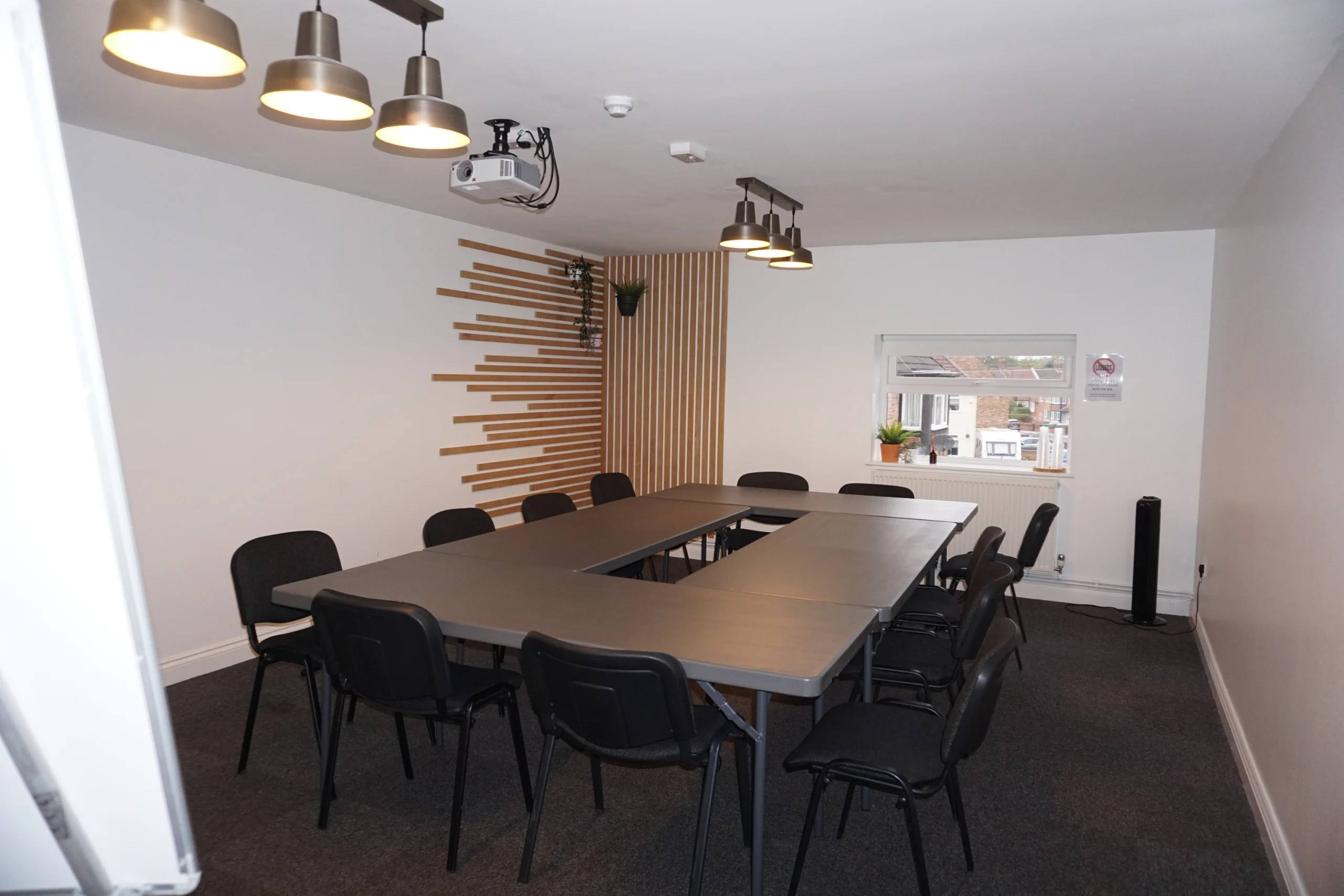
Start with what the session involves
The same room can hold twice as many people in rows as at round tables, so the layout matters as much as the room size. Decide how people will spend the day first: listening, writing, talking in pairs, working in groups or moving around. Then pick the layout that suits it.
The layouts, and when to use each
U-shape
Training with lots of talking. Everyone can see each other, and the trainer can step inside the U.
- Good for: Discussion, role play and courses where the trainer moves around. Everyone can see everyone else.
- Watch for: Takes more space per person than rows, so it suits smaller groups, usually up to about 20.
Classroom
Courses with notes or laptops. Everyone faces the front.
- Good for: Courses with workbooks, laptops or exams. Everyone faces the screen with a table to write on.
- Watch for: People talk to the front, not to each other. Less good for discussion.
Cabaret
Group work at round tables. Every seat faces the screen.
- Good for: Group work and workshops. Tables of five or six, with every seat turned towards the screen.
- Watch for: Needs the most floor space, so a room holds fewer people in cabaret than in rows.
Boardroom
Meetings, interviews and small groups around one table.
- Good for: Meetings, interviews, supervision and small group training around one table.
- Watch for: Works for small groups only. Beyond about 14, people at the far end struggle to see the screen.
Theatre
Talks and briefings. Rows of chairs face the front, with no tables.
- Good for: Briefings, talks and awareness sessions where nobody needs to write.
- Watch for: No tables, so it is the wrong choice for a long day or anything with paperwork.
Banquet
Lunches and networking around full round tables.
- Good for: Lunches and networking around full round tables.
- Watch for: Half the table has its back to the screen, so it is a poor choice for training.
Quick guide
| Your session | Layout to ask for |
|---|---|
| Discussion-led training, up to about 20 | U-shape |
| Course with workbooks, laptops or a test | Classroom |
| Workshop with group exercises | Cabaret |
| Meeting, interview or supervision | Boardroom |
| Briefing or talk, no writing | Theatre |
| Practical skills on the floor | Chairs round the edge, floor clear |
Things to ask the venue
- Can everyone see the screen from every seat in that layout?
- Is there space for the trainer to walk around, and for a flipchart?
- Where are the power sockets, if delegates bring laptops?
- Is there a second room or space for breakout groups?
- Will the room be set before you arrive, or do you set it yourself?
How we do it
At the Maggie O'Neill Centre we don't publish a capacity chart, because the right number depends on the layout and what the day involves. Tell us how many people are coming and what the day involves. Then we'll pick the right room and layout. We'll set it up before you arrive.
Planning the whole day? Read our training day checklist, or see our training rooms near Liverpool and meeting rooms.